1. Decide How Many Trekking Days You Have
More available days give you access to longer itineraries such as eight day Lemosho or nine day Northern Circuit.

Discover the Best Kilimanjaro Route for Beginners, comparing Lemosho, Machame, Rongai, Marangu and Northern Circuit for acclimatization, scenery and support.
The Best Kilimanjaro Route for Beginners depends on available trekking days, fitness, altitude experience, preferred accommodation and how gradually the itinerary gains elevation. Longer routes such as the 8 day Lemosho and 9 day Northern Circuit provide additional mountain time, while 7 day Machame and 7 day Rongai can also suit first time Kilimanjaro climbers.
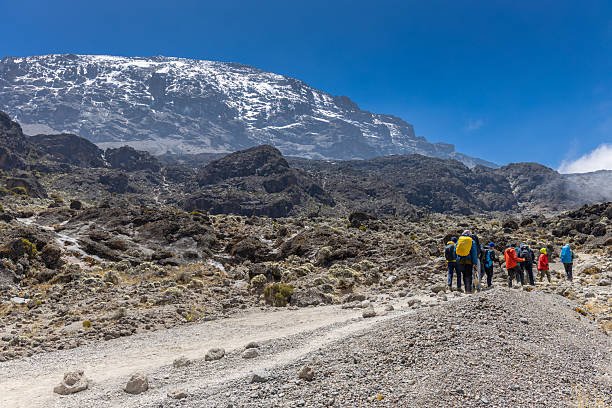
For many beginners, the 8 day Lemosho Route is a strong option because it combines gradual altitude progression with Shira Plateau, Lava Tower, Barranco, Karanga and Barafu before the summit attempt. Travellers who prefer a northern approach can consider the 7 day Rongai Route, while those wanting hut accommodation may look at Marangu.
No Kilimanjaro route is automatically easy, and choosing a longer itinerary does not guarantee the summit. Beginners should compare acclimatization time, terrain, camping or hut accommodation, guide support, physical preparation and overall itinerary design before selecting the route that best matches their travel plans.
Choosing the Best Kilimanjaro Route for Beginners is less about finding an easy trail and more about selecting an itinerary that provides enough mountain time, manageable daily stages and appropriate professional support.
Mount Kilimanjaro does not normally require technical mountaineering skills on the standard trekking routes, but every route involves high altitude, cold conditions, consecutive trekking days and a demanding summit attempt.
For first time climbers, route duration can be particularly important because a slower itinerary gives the body additional time to respond to increasing elevation.
The 8 day Lemosho Route, 7 day Machame Route, 7 day Rongai Route and 9 day Northern Circuit all provide different ways of approaching Kilimanjaro with more mountain time than the shortest itineraries.
Marangu can appeal to beginners who prefer hut accommodation, but travellers should still consider itinerary length and altitude progression rather than choosing it only because it avoids camping.
No single route is automatically best for every first time climber.
A traveller with strong hiking experience but limited vacation time may prioritize a different route from someone who has never trekked at altitude and can spend nine days on the mountain.
Accommodation preferences also matter. Some travellers enjoy camping, while others strongly prefer the hut based accommodation available on Marangu.
Weather preferences, travel dates, group structure and available budget can also influence the decision.
The 8 day Lemosho Route is one of the most complete options for first time Kilimanjaro climbers who have enough time for a longer itinerary.
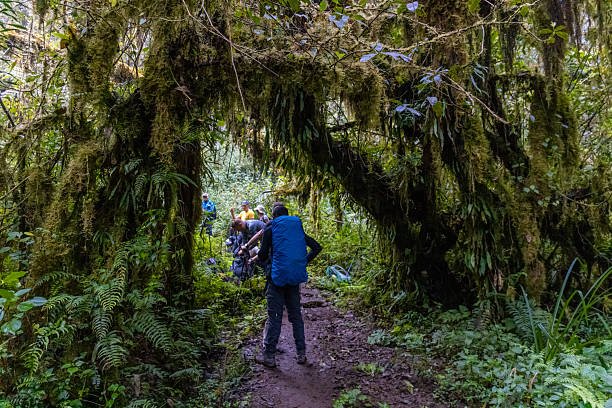
The route begins from the western side and progresses through the forest before reaching the broad Shira Plateau.
It then continues toward Lava Tower, Barranco, Karanga and Barafu before the summit attempt toward Uhuru Peak.
The eight day itinerary normally includes a separate Karanga overnight, creating an additional mountain stage before climbers reach Barafu.
This provides a more gradual schedule than shorter versions of the same route.
One important feature of Lemosho is the higher daytime exposure around Lava Tower followed by descent toward Barranco.
This gives climbers an opportunity to experience higher elevation before sleeping lower.
Some beginners notice headache, fatigue or reduced appetite during this stage even when the previous days felt comfortable.
Symptoms should be reported honestly to the professional guide team.
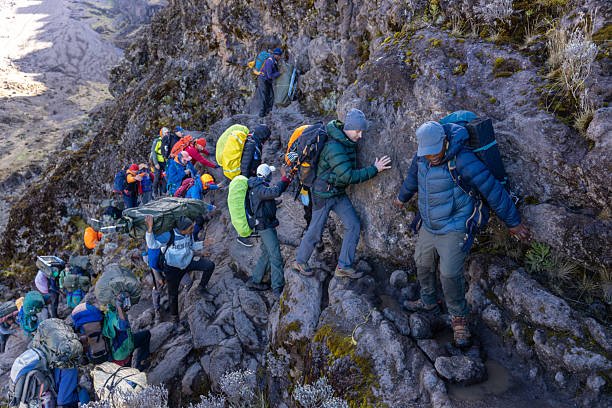
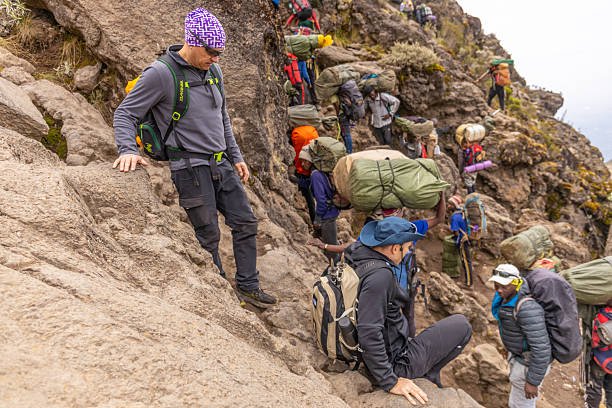
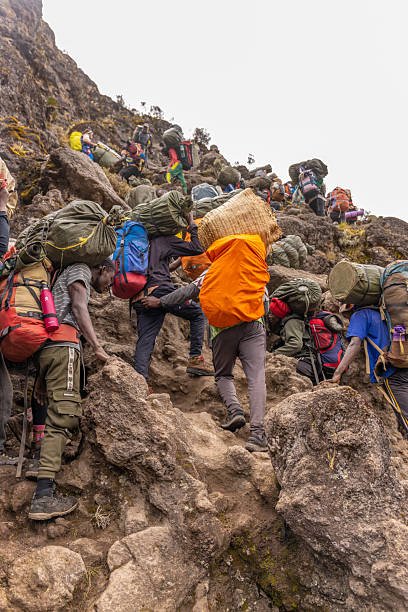
Barranco Wall can look intimidating from the camp below, but it forms part of the standard Lemosho and Machame trekking routes.
Technical mountaineering equipment is not normally required.
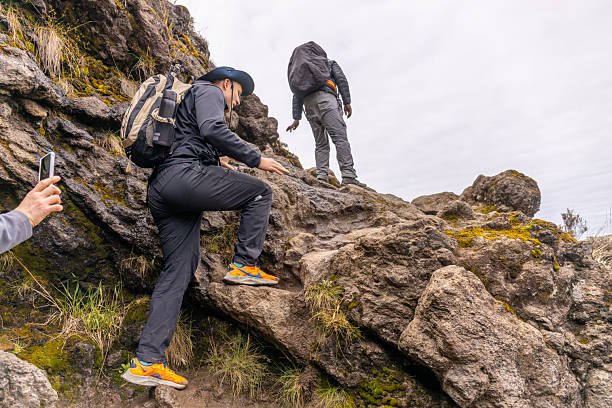
There are sections where climbers use their hands for balance and follow guide instructions carefully.
A beginner who is comfortable hiking on uneven terrain can often manage the wall with patience and appropriate professional support.
Beginners sometimes worry about Barranco Wall more than summit night because the wall looks dramatic in photographs.
The greater challenge on Kilimanjaro is usually the combination of high altitude, cold and fatigue during the summit stage.
The 7 day Machame Route can also be suitable for first time Kilimanjaro climbers who want a scenic camping route.
The itinerary approaches from the southern side and travels through Machame Camp, Shira, Lava Tower, Barranco, Karanga and Barafu.
The seven day version includes a separate overnight at Karanga before continuing to Barafu.
This creates a more gradual pre summit schedule than the common six day Machame itinerary.
Both routes eventually join parts of Kilimanjaro's southern circuit and include Lava Tower, Barranco Wall, Karanga and Barafu.
Lemosho begins farther west and provides an additional trekking day in the common eight day version.
Machame begins from the southern side and reaches Shira more quickly.
A beginner with enough time who prioritizes additional mountain days can consider the eight day Lemosho schedule, while seven day Machame can suit travellers with a slightly shorter available window.
The 7 day Rongai Route approaches Kilimanjaro from the northern side.
It follows a very different landscape and camp sequence from Lemosho and Machame.
The seven day itinerary commonly includes Simba Camp, Second Cave, Kikelewa, Mawenzi Tarn and Kibo.
Adding Second Cave as a separate overnight makes the seven day schedule more gradual than the common six day Rongai itinerary.
Marangu is often considered by first time climbers because it uses hut accommodation rather than camping for the standard route.
The six day itinerary includes a dedicated acclimatization day around Horombo before climbers continue toward Kibo.
This can appeal to travellers who strongly prefer sleeping in mountain huts.
However, hut accommodation should not be confused with an easy climb. Summit night remains demanding and high altitude remains the main challenge.
Marangu is sometimes described as easier because it has hut accommodation and avoids some features such as Barranco Wall.
That description can be misleading.
The summit still requires climbing to extreme altitude, and the number of days available for acclimatization matters greatly.
Beginners should therefore consider the complete altitude schedule rather than choosing Marangu simply because huts sound more comfortable.
The Northern Circuit is one of the longest standard Kilimanjaro itineraries.
It begins through the western Lemosho approach and later traverses around the northern side through Moir, Buffalo Camp and Third Cave.
The expedition commonly prepares for summit night around School Hut before descending through Mweka after the summit section.
Its long duration can appeal to first time climbers who prioritize additional mountain time and have enough days available for the expedition.
More mountain days can support gradual altitude progression, but route length is not the only consideration.
A longer route also means spending more nights camping, walking for more consecutive days and requiring a larger total time commitment.
Some beginners may prefer eight days on Lemosho rather than nine days on Northern Circuit because of available holiday time and personal travel preferences.
The most suitable itinerary balances acclimatization time, physical endurance, accommodation preference and total trip length.
Longer itineraries generally provide more opportunities to spread altitude gain over additional mountain days.
The 9 day Northern Circuit and 8 day Lemosho provide substantial mountain time, while 7 day Machame and 7 day Rongai provide intermediate options.
However, route profiles are not identical, so simply counting the number of days does not tell the entire story.
Lemosho, Machame, Rongai and Northern Circuit all use camping for significant parts of their standard itineraries.
Camping allows climbers to experience different areas of Kilimanjaro and stay at designated mountain camps along the route.
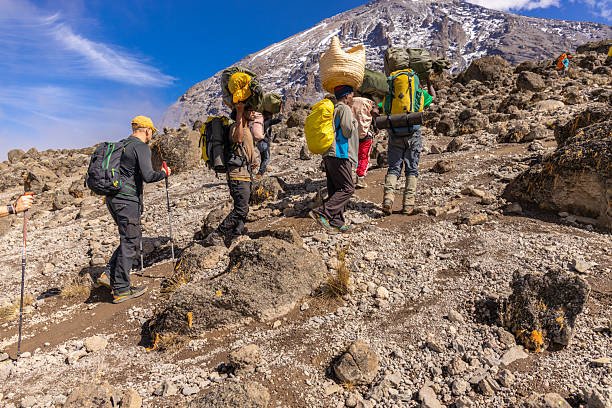
Porters transport the main camping equipment between camps while climbers carry their personal daypacks.
Marangu is the main Kilimanjaro route associated with hut based mountain accommodation.
This can appeal to beginners who prefer not to sleep in tents.
The tradeoff is that route choice should still be based on altitude progression and itinerary structure rather than accommodation alone.
Lemosho and Machame travel through several contrasting ecological and mountain zones.
These can include forest, Shira landscapes, Lava Tower, Barranco and high alpine terrain.
Scenery depends on weather and visibility, but the route progression provides substantial variety.
Rongai approaches directly from northern Kilimanjaro, while Northern Circuit begins from the west and later traverses around the northern slopes.
These routes provide alternatives for travellers who prefer a different route experience from the southern Machame and Lemosho circuits.
Standard Kilimanjaro trekking routes do not normally require technical climbing experience.
For many beginners, altitude is the greater uncertainty.
A strong runner, cyclist or gym athlete can still experience altitude related symptoms.
Physical fitness helps with trekking workload but does not guarantee successful acclimatization.
Fitness can make walking easier, but it cannot predict exactly how the body will respond to high elevation.
This is why beginners should value itinerary length and professional monitoring alongside physical training.
Training should focus on building endurance rather than only short periods of intense exercise.
Regular hiking is particularly useful because Kilimanjaro involves walking for several consecutive days.
Brisk walking, stair climbing, cardiovascular training and lower body strengthening can also form part of preparation.
Long training hikes while carrying a daypack can help climbers become comfortable with extended trekking days.
Previous trekking experience is helpful but is not always required for standard Kilimanjaro routes.
A beginner should still be comfortable walking for several hours on uneven terrain.
Training hikes before travelling provide useful experience with boots, daypacks, hydration and pacing.
Walking slowly is one of the most important habits for a Kilimanjaro beginner.
Climbers should not allow excitement during the first days to make them walk faster than the guide's recommended pace.
Saving energy during the lower stages can become valuable as elevation increases.
Professional guides can conduct regular health assessments throughout the expedition.
They consider symptoms, appetite, energy, breathing, behaviour and the climber's overall condition.
Monitoring equipment can provide additional information where used, but no single reading should replace assessment of symptoms and the complete condition of the climber.
Headache, nausea, dizziness, unusual fatigue, confusion, breathing difficulty or other concerning symptoms should be communicated to the professional guide.
Reporting symptoms early helps the guide team monitor changes and make appropriate mountain decisions.
Professional guides play a central role throughout the climb.
They lead the route, manage daily pace, coordinate the support team, monitor climbers and conduct summit preparation.
Beginners should feel comfortable asking questions and discussing their condition honestly with the guide team.
Assistant guides become especially important when a group contains climbers moving at different speeds.
One climber may need to descend while another remains in suitable condition to continue.
Appropriate guide staffing allows individual mountain decisions to be managed more effectively.
Summit night is normally the most demanding part of a Kilimanjaro expedition.
Climbers move through darkness or early morning conditions at extreme altitude and low temperatures.
The pace should be deliberately slow and controlled.
Beginners should concentrate on following the professional guide rather than worrying about faster climbers or other groups.
First time climbers do not necessarily need to purchase every item if suitable rental equipment is available.
Selected items can be rented in Moshi according to size and availability.
A pre climb equipment check helps identify important missing or unsuitable items before the expedition.
Possible rental items can include sleeping bags, trekking poles, gaiters and selected warm or waterproof clothing.
Camping provides access to routes such as Lemosho, Machame, Rongai and Northern Circuit.
Marangu is different because the standard route uses mountain huts.
The decision should depend on personal comfort preferences as well as itinerary considerations.
Sleeping in a hut does not reduce the summit altitude, while sleeping in a tent does not automatically make a route more difficult to acclimatize on.
A private expedition can be suitable for first time climbers who want a dedicated guide team and a booking reserved for their own party.
Private climbing can simplify group logistics and provide greater departure date flexibility.
It does not mean the itinerary should be shortened or accelerated.
Altitude and route difficulty remain the same.
Beginners can also join scheduled Kilimanjaro group departures.
This can suit solo travellers and couples who enjoy meeting other climbers.
The professional guide should maintain an appropriate high altitude pace rather than allowing the fastest participant to control the entire group.
Solo travellers can consider group joining departures on Lemosho, Machame or other routes where scheduled groups are available.
They can also arrange a private expedition.
The route decision should be based on itinerary duration and personal preferences rather than travelling alone.
Couples can climb privately or join a group.
Longer itineraries such as 8 day Lemosho can be attractive when both travellers have enough time and prefer a gradual schedule.
Each person can still react differently to altitude, so couples should avoid assuming both climbers will have the same mountain experience.
Families should consider age, general health, trekking experience and high altitude suitability for every participant individually.
A longer itinerary can provide more mountain time, while a private expedition can make logistics easier for one family group.
Professional safety decisions still apply separately to each climber.
First time climbers can attempt Kilimanjaro without previous technical mountaineering experience.
However, no operator can guarantee that a particular beginner will reach Uhuru Peak.
Altitude response, physical condition, weather and health can change the outcome.
A responsible expedition should place safety ahead of summit pressure.
Choosing a longer route can improve the structure of the expedition, but no itinerary can guarantee an Uhuru Peak summit.
Professional guides can recommend stopping the ascent or descending when a climber's condition makes continuing unsafe.
Shorter Kilimanjaro itineraries provide less mountain time before summit night.
Travellers should therefore consider carefully whether reducing the number of days is worth the shorter travel schedule.
This is particularly important for people with no previous high altitude experience.
The lowest number of trekking days should not automatically be treated as the easiest option.
More available days give you access to longer itineraries such as eight day Lemosho or nine day Northern Circuit.
Camping provides more route choices, while Marangu can suit travellers who strongly prefer huts.
Travellers with no previous altitude experience can place extra value on a gradual itinerary with more mountain time.
Do not compare routes by name alone. Look at where you sleep each night and how the altitude progresses.
Confirm guide staffing, porter support, meals, health monitoring and summit procedures before booking.
Beginners should consider arriving with enough time to recover from international travel before starting the mountain.
A pre climb hotel night gives travellers time to rest, meet the guide and complete the equipment check.
Additional rest can be especially useful after long international flights.
Transfers between Kilimanjaro International Airport and Moshi can be arranged according to confirmed flights.
Beginners can therefore travel directly from the airport to their pre climb accommodation before attending the briefing and equipment check.
A northern Tanzania safari can be added after Kilimanjaro.
Travellers can continue toward Tarangire, Lake Manyara, Ngorongoro or Serengeti depending on their available travel days.
Many climbers prefer to schedule safari after the mountain rather than immediately before the expedition.
Zanzibar can be added after Kilimanjaro or after a combined mountain and safari itinerary.
This creates a Tanzania journey combining high altitude trekking with wildlife experiences and coastal relaxation.
There is no single route suitable for every beginner. Longer itineraries such as 8 day Lemosho and 9 day Northern Circuit provide substantial mountain time, while 7 day Machame and 7 day Rongai can also suit first time climbers.
Yes. The eight day Lemosho itinerary can suit beginners who want a longer western approach with several altitude exposure stages.
The seven day Machame itinerary can suit prepared first time climbers and includes a separate Karanga overnight before Barafu.
Yes. The seven day Rongai itinerary provides a northern approach with a separate Second Cave overnight and several stages before Kibo.
Marangu can suit beginners who prefer hut accommodation, especially when using a schedule that includes a dedicated acclimatization day.
It can suit beginners who have enough time for a long expedition and prefer substantial mountain time before summit day.
Standard trekking routes normally do not require technical mountaineering equipment, although high altitude and summit night make the expedition demanding.
Many first time climbers attempt Kilimanjaro, but appropriate physical preparation, equipment and professional guide support remain important.
Long itineraries such as 9 day Northern Circuit and 8 day Lemosho provide more trekking days than shorter Kilimanjaro routes.
Additional days can provide a more gradual altitude schedule, although individual acclimatization remains unpredictable.
No. A longer route can provide additional acclimatization time but cannot guarantee that any individual will reach Uhuru Peak.
Marangu is the main standard Kilimanjaro route associated with hut accommodation.
Lemosho, Machame, Northern Circuit and the camping sections of Rongai commonly use mountain tents.
It can look intimidating, but standard trekking normally does not require technical climbing equipment. Climbers should follow professional guide instructions carefully.
Good endurance helps, but climbers do not need to be elite athletes. They should be prepared for consecutive trekking days and a long summit stage.
No. Very fit climbers can still experience altitude related problems.
Training can include hiking, brisk walking, stair climbing, cardiovascular exercise and lower body strengthening, with longer hikes added gradually.
Yes. Practice hikes with a daypack can help climbers become comfortable with carrying water, clothing and personal items for several hours.
Selected trekking equipment can normally be rented in Moshi according to size and availability.
Trekking poles can be useful for uneven terrain, steep sections and long descents, particularly after summit day.
Yes. Private expeditions can be arranged for solo travellers, couples, families and groups.
Yes. Scheduled group departures can suit beginners when the itinerary, dates and route match their travel plans.
The climber should report symptoms immediately. The guide can recommend rest, further monitoring, stopping the ascent or descent depending on the overall condition.
No single reading should be used alone as a universal summit decision. Professional guides consider symptoms and the climber's overall condition together with monitoring information.
For many climbers, summit night is the most demanding stage because of extreme altitude, cold, darkness or early morning conditions and accumulated fatigue.
Yes. Tarangire, Lake Manyara, Ngorongoro and Serengeti can be added according to available travel time.
Yes. Zanzibar can be added after the climb or after a combined mountain and safari itinerary.
Compare longer Kilimanjaro itineraries such as 8 day Lemosho, 7 day Machame, 7 day Rongai, 6 day Marangu and 9 day Northern Circuit according to mountain time, accommodation and route style.
Choose a professionally guided itinerary with enough time for your travel plans, prepare properly for altitude and focus on responsible mountain support rather than searching for an easy or guaranteed route.
Plan Your First Kilimanjaro ClimbAfrican Trek & Travel is a leading Tanzania tour operator in Moshi and Arusha for 2026–2027, specializing in Kilimanjaro treks, safaris, and tailor-made adventures. With deep local expertise and a strong commitment to safety and quality, we deliver unforgettable travel experiences across East Africa.
Discover popular Safaris, Serengeti Migration, Kilimanjaro Climbing & Zanzibar Beach Holidays. Plan your perfect adventure today!
 Popular
Experience the wildebeest migration across the vast Serengeti and Ngorongoro plains. Perfect for wildlife lovers and photography enthusiasts.
Book Now New
Climb Africa’s highest peak via scenic routes with expert guides and safe treks. Experience adventure with full support and accommodation included.
Book Now Popular
Relax in paradise with pristine white beaches, spice tours, and cultural charm. Ideal for families and honeymooners seeking luxury and tranquility.
Book Now




We collaborate with top tour operators to provide the best experiences for Kilimanjaro treks, safaris, and adventures.