Kilimanjaro Guides and Porters
Kilimanjaro Guides and Porters are essential to the organization of a Mount Kilimanjaro expedition.
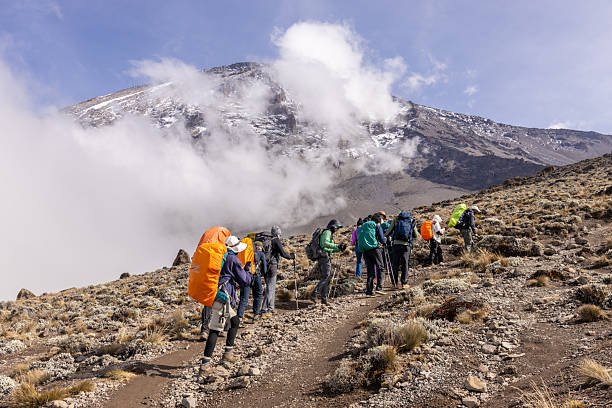
Climbers normally carry only a personal daypack while the wider mountain team manages guiding, food preparation, equipment transport and camp or hut logistics according to the route.
The guide team is responsible for much more than showing the direction of the trail.
Guides manage walking pace, daily schedules, health monitoring, altitude related decisions, route conditions and summit planning.
Assistant guides provide additional support and may work closely with individual climbers who need a different pace or additional attention.
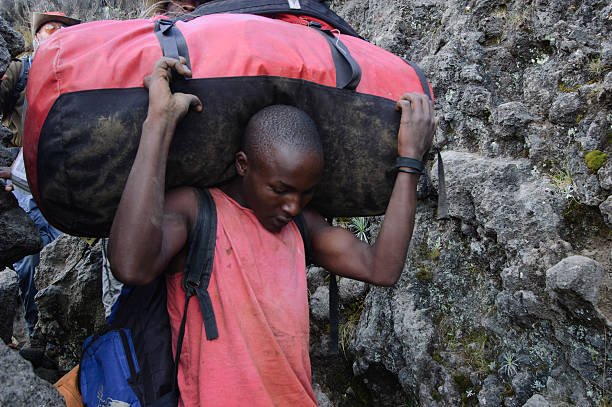
Porters transport expedition supplies and personal duffels within the applicable baggage allowance.
Cooks prepare meals during the mountain trek according to the confirmed program.
Together, these roles create the support system that allows climbers to focus primarily on walking, acclimatizing, eating, drinking and resting.
The exact size of the crew depends on the number of climbers, route, trek duration and operational requirements.
Understanding the crew structure before departure also helps travellers pack correctly, plan gratuities and know whom to speak with if they need assistance.
Kilimanjaro Mountain Crew at a Glance
- Lead guide: Overall trek management, pacing, safety and health monitoring
- Assistant guides: Additional climber support and summit assistance
- Cook: Prepares mountain meals according to the confirmed program
- Porters: Carry expedition equipment and guest duffels within applicable limits
- Crew size: Depends on climber numbers, route and logistics
- Climber responsibility: Carry a personal daypack and follow guide instructions
- Summit support: Additional guide or porter assistance may be arranged according to the expedition
What Does a Kilimanjaro Guide Do?
The lead guide has overall responsibility for the climbers during the mountain trek.
The role includes daily route management, walking pace, timing, communication and coordination with the rest of the crew.
As the group gains altitude, health monitoring becomes one of the guide's most important responsibilities.
The guide may ask climbers about headache, nausea, appetite, dizziness, sleep, hydration and unusual fatigue.
These discussions help the guide understand how each person is responding to altitude.
The guide also explains the plan for the next trekking day and prepares climbers for important sections such as Barranco Wall, Lava Tower, Kibo Hut, Barafu Camp or summit night depending on the selected route.
Guide Responsibility for Mountain Safety
Kilimanjaro is a high altitude mountain.
A professional guide therefore has to make decisions based on more than the climber's desire to reach Uhuru Peak.
If a climber develops concerning altitude symptoms, illness, severe exhaustion or another safety problem, the guide may recommend slowing down, stopping the ascent or descending.
These decisions are part of responsible guiding.
Reaching the summit should never be prioritized over safe descent.
The Guide's Priority Is Safe Progress
A good guide does not simply push every climber toward the summit. Pace, altitude response, weather, fatigue and individual health all influence whether continuing higher is appropriate.
What Does an Assistant Guide Do?
Assistant guides support the lead guide and provide additional attention to climbers.
This becomes increasingly useful as group size grows.
Not every climber walks at exactly the same speed.
An assistant guide may stay with one part of the group while the lead guide manages another section.
During summit night, assistant guides can be especially important because climbers may naturally separate according to pace and condition.
Why Multiple Guides May Be Needed
A larger climbing group normally requires more guide support.
This allows different climbers to move at safe individual paces without forcing everyone into exactly the same rhythm.
It also provides additional support if a climber needs to descend while other members of the group are able to continue.
The exact guide ratio depends on the confirmed expedition arrangements and applicable requirements.
What Does a Kilimanjaro Porter Do?
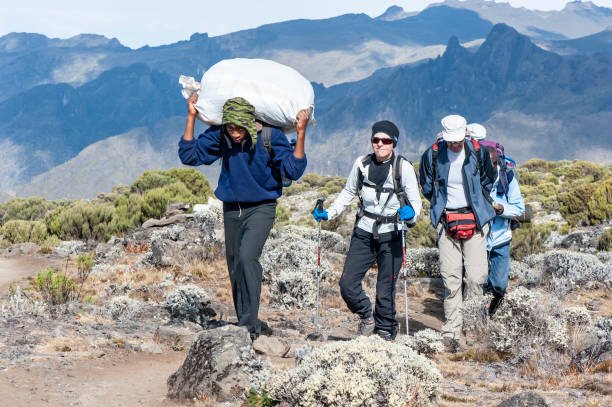
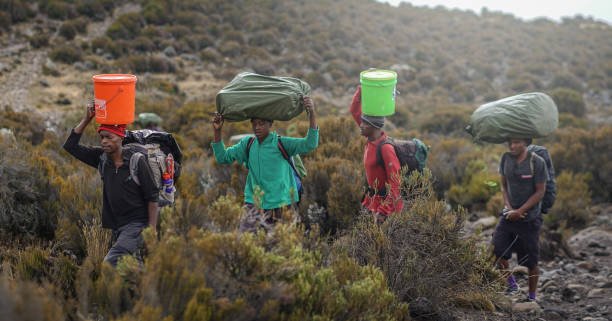
Porters are responsible for transporting much of the expedition equipment between camps or huts.
On camping routes, this may include tents, kitchen equipment, food, crew supplies and guest duffels.
On the Marangu Route, hut accommodation changes some of the logistics, but porters still transport supplies and personal luggage.
This support allows climbers to walk with a smaller personal daypack rather than carrying their full expedition luggage.
What Do Porters Carry?
The exact load depends on route and expedition arrangements.
Porters may carry camping equipment, food, cooking equipment and guest duffels.
Some equipment is shared by the entire expedition, while personal duffels contain individual trekking items.
Climbers should remain within the confirmed baggage allowance.
Responsible packing reduces unnecessary load and makes mountain logistics easier for the crew.
Kilimanjaro Porter Weight Limit
Personal luggage handed to the porter must remain within the applicable allowance communicated before the climb.
The climber should not assume that extra luggage can simply be added at the trailhead.
Unnecessary travel clothing, suitcases and items that are not needed on the mountain can normally remain in suitable storage according to the confirmed arrangement.
Pack carefully before the climb and weigh the duffel if necessary.
What Does the Climber Carry?
Climbers normally carry a personal daypack during the trek.
This contains everything that may be needed while walking because the main duffel may travel ahead with the porters.
Typical Daypack Items
- Water
- Waterproof jacket and trousers
- Warm layer
- Personal snacks
- Personal medication
- Sun protection
- Sunglasses
- Camera or phone
- Other personal essentials needed during the walking day
Why Porters Often Walk Faster Than Climbers
Porters frequently leave after climbers and arrive at the next camp earlier.
This allows the mountain team to organize equipment, food and accommodation before guests arrive.
Their pace should not encourage climbers to walk faster.
Climbers have a different objective: conserving energy and acclimatizing gradually.
Follow the guide's pace rather than trying to keep up with porters.
What Does the Kilimanjaro Cook Do?
The cook prepares meals for climbers during the expedition according to the confirmed package.
Cooking on Kilimanjaro requires working with limited mountain facilities and changing conditions.
The cook coordinates with the porter team to ensure food and kitchen supplies reach the correct camp.
Dietary requirements and allergies should be communicated before the trek so arrangements can be discussed in advance.
Mountain Meals and the Crew
Good nutrition supports climbers during consecutive trekking days.
Appetite can decrease at altitude, making meal planning important.
The exact menu depends on the confirmed trekking program.
Climbers should tell the guide if they are struggling to eat or experiencing nausea because this may also be relevant to altitude monitoring.
How Large Is a Kilimanjaro Crew?
The crew size changes according to the number of climbers.
A small private group may still require several mountain staff because guiding, food and equipment support remain necessary.
A larger group requires more guides and porters.
This is one reason private climbs can have a higher operational cost per traveller than larger group departures.
Example Crew Structure
A mountain team can include a lead guide, one or more assistant guides, a cook and a number of porters.
The exact staffing should be confirmed for the actual expedition rather than assumed from another group's crew.
Different routes, group sizes and logistical requirements can change the numbers.
Crew Support on Private Kilimanjaro Climbs
A private climb provides a dedicated mountain team for the confirmed guests.
The guide team can focus on the private group's pace and condition within the planned itinerary.
However, mountain safety and altitude still determine what adjustments are appropriate.
A private trek does not guarantee that every requested schedule change can be made at high altitude.
Crew Support on Group Joining Climbs
A group joining climb brings travellers together on a shared route and itinerary.
The guide team manages the group while still monitoring each climber individually.
Altitude response can differ significantly between people.
A group member who feels strong should not pressure another climber to move faster.
Guides and Altitude Monitoring
Altitude is one of the most important challenges on Kilimanjaro.
Guides may conduct regular health checks according to the confirmed program.
These may include asking about symptoms, appetite, sleep, hydration and general condition.
A pulse oximeter may also be used as one part of the assessment where included.
No single device reading should replace evaluation of the climber's symptoms and overall condition.
Symptoms Climbers Should Report
Climbers should tell their guide about headache, nausea, dizziness, reduced appetite, unusual fatigue, sleep problems or any significant change in condition.
Symptoms should not be hidden to protect a summit attempt.
Accurate communication gives the guide better information for making safety decisions.
Speak Honestly with Your Guide
The guide cannot properly assess what you do not report. Headache, nausea, dizziness, unusual fatigue and other changes should be communicated openly as altitude increases.
Emergency Oxygen and First Aid
Emergency oxygen and first aid equipment may be carried according to the confirmed mountain safety arrangements.
These resources are intended to support emergency management.
They should not be viewed as permission to continue climbing when descent is necessary.
The guide should explain relevant emergency procedures during the pre climb briefing.
What Happens If a Climber Needs to Descend?
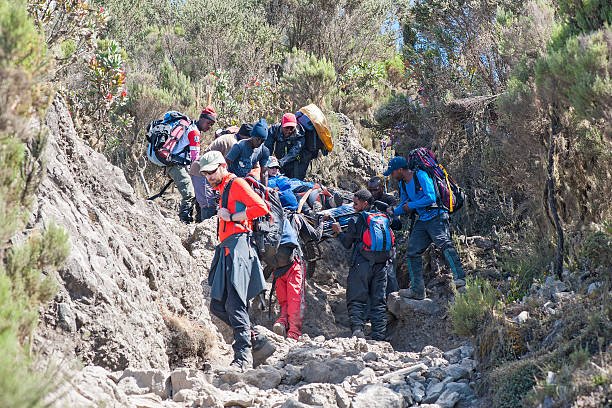
If a climber cannot safely continue, part of the guide team may assist with descent while the remaining group follows the appropriate plan.
This is one reason adequate guide support is important.
The exact response depends on the climber's condition, location, route and available mountain resources.
Travel insurance should be suitable for the planned altitude and include relevant medical and evacuation coverage according to the policy.
Guides on Summit Night
Summit night is usually the most demanding part of the Kilimanjaro expedition.
The guide team checks climber condition, clothing and readiness before departure.
The ascent normally begins late at night or in the early hours depending on route and guide planning.
The group moves slowly because of darkness, cold and high altitude.
Guides monitor climbers throughout the ascent.
Summit Support Porters
Some expedition arrangements may include porters who provide additional support during the summit section.
The exact level of summit support depends on the operator, group size and confirmed crew arrangement.
Support may become useful when climbers naturally separate according to pace.
Any summit assistance should still follow the guide's safety decisions.
Guide to Climber Communication on Summit Night
Climbers should tell guides immediately about concerning changes in how they feel.
Do not assume that severe fatigue, confusion or balance problems are simply normal because summit night is difficult.
The guide may slow the pace, stop the climb or begin descent depending on the situation.
Guides on Machame Route
Machame uses camping accommodation and passes through several distinct mountain environments.
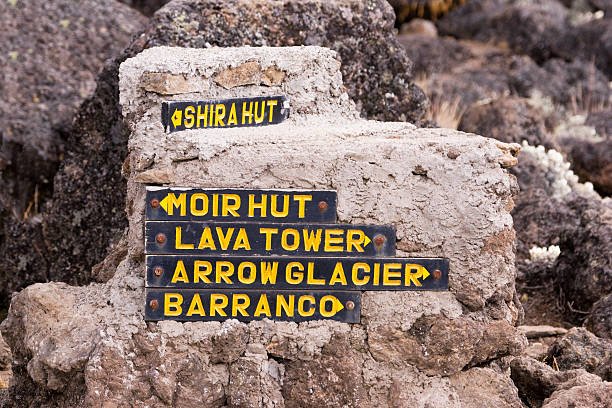
Depending on itinerary length, guides lead climbers through areas such as Shira, Lava Tower, Barranco, Karanga and Barafu.
The guide also manages Barranco Wall and summit preparation.
Guides on Lemosho Route
Lemosho begins on the western side of Kilimanjaro before joining the southern circuit.
Guides manage acclimatization days, pace, camp progression and sections such as Lava Tower and Barranco.
Seven and eight day itineraries provide different schedules, so climbers should review the exact route before departure.
Guides on Marangu Route
Marangu uses huts rather than standard camping tents.
Guides lead climbers through Mandara, Horombo and Kibo according to the selected itinerary.
The six day version normally includes an additional acclimatization day around Horombo before continuing to Kibo.
The summit approach follows the Marangu side toward the crater rim and potentially Uhuru Peak where conditions and climber health allow.
Guides on Rongai Route
Rongai approaches from the northern side and uses camping during the ascent.
Guides lead the group through the selected camp schedule toward Kibo and the summit zone.
The descent normally follows the Marangu side.
Guides on Northern Circuit
The Northern Circuit uses a longer journey around the mountain.
Guides manage multiple trekking days and gradual progression around Kilimanjaro before the final summit approach.
Longer routes still require careful pacing and health monitoring despite providing additional time at altitude.
Porters on Camping Routes
Camping routes require transport of tents and additional camp equipment.
Porters may reach camp ahead of climbers so accommodation and other logistics can be organized.
The climber should keep essential daily equipment in the personal daypack because the main duffel may not remain accessible while walking.
Porters on the Marangu Route
Marangu does not use standard guest camping tents because climbers sleep in huts.
However, porters are still required for food, supplies and personal luggage.
Hut accommodation therefore does not eliminate the need for a mountain support team.
Responsible Packing for Porter Welfare
One practical way climbers can support the mountain crew is by following the luggage limit.
Pack only equipment that is genuinely needed.
Leave unnecessary travel luggage in appropriate storage.
Do not arrive at the gate with an overweight duffel and expect the crew to solve the problem without changing logistics.
Respecting Kilimanjaro Porters
Porters should be treated as professional members of the expedition team.
Basic respect includes learning crew roles, following baggage limits and communicating politely.
Climbers should avoid treating porters simply as anonymous luggage carriers.
Their work is essential to the operation of the expedition.
Respecting Kilimanjaro Guides
A professional relationship between climber and guide is important.
Ask questions when something is unclear.
Follow instructions related to pace, route safety and health.
Do not pressure guides to ignore concerning symptoms simply because reaching the summit is personally important.
Can You Request a Specific Guide?
A specific guide may sometimes be requested according to availability and the operator's scheduling.
This is most practical when arranged before the trek rather than after crew assignments have already been finalized.
The final guide team should match the group size and operational requirements.
Can You Meet Your Guide before the Trek?
A pre climb briefing is a useful opportunity to meet the guide team where arrangements allow.
During the briefing, climbers can review equipment, route details, baggage, health information and summit expectations.
This is also the right time to ask questions about anything that remains unclear.
Equipment Check with the Guide
The guide may review important mountain equipment before departure according to the trekking arrangement.
Missing items can sometimes be rented or purchased before the trek where available.
Do not wait until reaching a high mountain camp to discover that essential summit clothing is missing.
Guide Advice about Walking Pace
The guide normally encourages a slow pace from the beginning.
This may feel unusually slow to fit climbers at lower elevation.
However, Kilimanjaro is not a race.
The purpose is to conserve energy and give the body time to adjust as altitude increases.
What Does “Pole Pole” Mean?
“Pole pole” is a Swahili phrase commonly heard on Kilimanjaro.
It means slowly or gently.
Guides use it to encourage a controlled pace rather than unnecessary speed.
Climbers should become comfortable with walking much slower than they may normally hike at home.
Guide Support at Barranco Wall
Machame and Lemosho based itineraries may include Barranco Wall.
The section can appear steep when viewed from camp.
It is generally treated as a nontechnical scrambling section on standard trekking itineraries.
Guides show climbers the appropriate line and help manage movement through busier areas.
Guide Support at Lava Tower
Lava Tower reaches approximately 4,600 metres and is an important high point on several routes.
Climbers may notice altitude symptoms during this stage.
The guide monitors the group and controls the pace before continuing toward the planned overnight camp.
Guide Support during the Descent
Mountain safety continues after the summit attempt.
The descent can be tiring for the knees and legs.
Guides manage the route and may encourage climbers to slow down on loose or uneven terrain.
Trekking poles may be useful for some people.
What Happens to the Crew after Summit Day?
The crew continues working after climbers leave the summit zone.
Equipment still has to move down the mountain.
Meals, accommodation and logistics continue until the trek is completed at the gate.
This is why the expedition should be viewed as a complete team effort from the first day to the final descent.
Tipping Kilimanjaro Guides and Porters
Tipping is normally separate from the trekking package price unless the confirmed quotation states otherwise.
The final amount depends on route duration, group size and crew structure.
A practical budgeting guideline for a seven day group climb may be approximately USD 350 to USD 450 per climber for the overall crew gratuity.
The final tip remains a personal decision and should be distributed transparently among the confirmed mountain team.
Who Should Receive Kilimanjaro Tips?
The lead guide should not be the only person considered.
Assistant guides, cooks and porters also contribute to the trek.
Confirm the final crew numbers before calculating the distribution.
This is particularly important for larger groups where many porters may be involved.
Recognize the Whole Mountain Team
Guides may be the crew members climbers know best, but cooks and porters are also essential. A clear tipping system should recognize the wider expedition team.
When Are Tips Normally Given?
Tips are generally organized near the end of the trek.
The group can prepare the calculation before the final descent so that the process does not become rushed at the mountain gate.
The guide or operator can explain the preferred distribution method.
Crew Tipping Ceremony
Some expeditions finish with an informal ceremony or thank you gathering.
This may involve songs, introductions and recognition of the mountain team.
The exact format varies.
The important principle is that gratuities should be handled clearly and respectfully.
Can Equipment Be Donated to Guides or Porters?
Some climbers choose to give usable trekking equipment to crew members after the expedition.
This can be appreciated when the equipment is in good condition and useful to the recipient.
Equipment donations should generally be considered separately from the planned cash gratuity.
Damaged or unusable equipment should not be presented as a valuable gift.
Questions to Ask about Your Kilimanjaro Crew
- How many guides will support our group?
- Will there be assistant guides?
- How many porters are expected?
- Is there a dedicated cook?
- What is the personal duffel allowance?
- How are daily health checks managed?
- What safety equipment is carried?
- How is summit support arranged?
- How are crew tips normally distributed?
How Climbers Can Help the Crew
Climbers do not need to perform the crew's work, but simple preparation makes operations easier.
Pack within the permitted weight.
Be ready to depart at the agreed time.
Keep the tent or hut area reasonably organized.
Communicate dietary and medical information in advance.
Follow guide instructions and treat all crew members respectfully.
Common Misunderstandings about Kilimanjaro Guides and Porters
- The guide does more than simply show the trail
- Porters do not carry the climber's daypack under normal arrangements
- Main luggage must remain within the applicable allowance
- Hut routes still require porters
- Fit climbers still need guide health monitoring
- Assistant guides are important members of the team
- Summit success is not the only measure of guide quality
- Tips should recognize the wider mountain crew
Kilimanjaro Guides and Porters Checklist
Before Starting Your Trek
- Attend the pre climb briefing
- Meet the guide team where arranged
- Confirm your route and daily schedule
- Confirm the duffel baggage allowance
- Pack only necessary mountain equipment
- Keep daily essentials in your daypack
- Declare allergies and dietary requirements
- Tell the guide about relevant concerns
- Understand daily health monitoring
- Understand summit night procedures
- Ask about emergency procedures
- Budget separately for crew gratuities where excluded
Frequently Asked Questions
Why do Kilimanjaro climbers need guides and porters?
Guides manage route progress, pace, health and safety, while porters transport expedition equipment and personal duffels according to the confirmed mountain arrangement.
What does the lead guide do?
The lead guide manages the climbing group, daily schedule, walking pace, health monitoring, route decisions, summit planning and mountain safety.
What do assistant guides do?
Assistant guides provide additional climber support, help monitor the group and may accompany climbers moving at different speeds or requiring individual assistance.
What do Kilimanjaro porters carry?
Porters may carry guest duffels, expedition supplies, food and route specific equipment such as camping gear according to the applicable limits.
Do porters carry my daypack?
Climbers normally carry their own daypacks containing water, clothing, snacks, medication and other daily essentials.
How much luggage can I give to a porter?
Your personal duffel should remain within the applicable baggage allowance communicated for the confirmed trek.
Do Marangu climbers still need porters?
Yes. Although Marangu uses huts rather than camping tents, porters are still needed to transport supplies and personal luggage.
How many guides will our group have?
Guide numbers depend on the number of climbers and the confirmed expedition arrangement. Larger groups normally require additional guide support.
How many porters will our group have?
Porter numbers depend on group size, route, trek duration and the equipment required. Ask for the final crew details for your specific expedition.
Does every Kilimanjaro group have a cook?
A cook is normally part of supported multi day trekking arrangements where mountain meals are included, subject to the confirmed package.
Do guides monitor altitude sickness?
Yes. Professional guides monitor climber wellbeing and may ask regularly about symptoms such as headache, nausea, appetite, dizziness, sleep and fatigue.
Can a Kilimanjaro guide tell me to descend?
Yes. A guide may recommend or require descent when altitude symptoms, illness, exhaustion or another safety concern makes continuing inappropriate.
What happens if one climber descends early?
Part of the guide team may assist with descent while the rest of the group follows the appropriate plan, depending on the actual circumstances and crew arrangement.
Do porters help on summit night?
Additional summit porter support may be included on some expeditions according to the confirmed crew arrangement and group requirements.
Can I request a particular guide?
A specific guide may sometimes be requested subject to availability and advance scheduling.
Will I meet my guide before the climb?
A pre climb briefing may provide an opportunity to meet the guide, review the route and check equipment according to the confirmed arrangements.
How much should I tip Kilimanjaro guides and porters?
The amount depends on route duration, group size and crew composition. For a seven day group climb, approximately USD 350 to USD 450 per climber can be used as a practical overall crew tipping guideline.
Should I tip only the guide?
No. The wider crew may include assistant guides, cooks and porters, and the gratuity system should recognize the full team.
Can I donate trekking equipment to the crew?
Useful equipment in good condition may be donated if the recipient wants it, but equipment should normally be separate from the planned monetary gratuity.
Why do porters arrive at camp before climbers?
Porters often move ahead so expedition equipment, food and camp logistics can be prepared before the trekking group arrives.
Should I try to walk as fast as the porters?
No. Climbers should follow the guide's slow and controlled pace rather than comparing themselves with crew members moving for different operational reasons.
What is the most important thing to know about Kilimanjaro guides and porters?
A Kilimanjaro climb is a team operation. Guides manage climber progress and safety, while assistant guides, cooks and porters provide the support that allows the expedition to function from the trailhead to the final descent.
Climb Kilimanjaro with a Professional Mountain Team
A well organized Kilimanjaro expedition depends on experienced guides, assistant guides, cooks and porters working together to support trekking logistics, health monitoring, meals, equipment and summit preparation.
Plan Your Kilimanjaro Climb

 Kilimanjaro Climb