Kilimanjaro Rescue and Evacuation
Kilimanjaro Rescue and Evacuation procedures are an important part of preparing for a safe climb of Mount Kilimanjaro.
Most trekkers complete their trip without requiring an emergency evacuation, but guides and climbers should understand what happens if altitude illness, injury, severe exhaustion or another medical problem makes continued trekking unsafe.
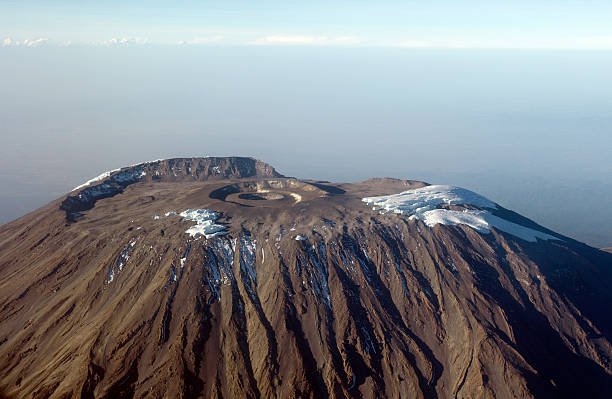
Mount Kilimanjaro reaches 5,895 metres at Uhuru Peak. The combination of high altitude, changing weather, uneven trails, long walking days and remote mountain camps means emergency plans must be practical and capable of changing according to the climber's location and condition.
On Kilimanjaro, rescue does not always mean a helicopter. Many situations are managed through rapid descent on foot, assisted walking or ground evacuation using additional crew and mountain rescue equipment.
Helicopter evacuation may be available in certain circumstances, but operations depend on weather, visibility, landing or extraction conditions, aircraft availability, location and other operational factors.
A helicopter should therefore never be treated as guaranteed access from every camp or at every time.
The most important principle is early action. When a guide determines that a climber should descend, delaying evacuation simply to preserve the possibility of reaching the summit can increase risk.
The Kilimanjaro Rescue and Evacuation plan should be discussed before the climb so travellers understand emergency communication, descent procedures, insurance responsibilities and what assistance the mountain crew can provide.
Kilimanjaro Rescue and Evacuation at a Glance
- First priority: Protect the climber's health rather than the summit attempt.
- Most immediate response: Stop ascending and assess the climber.
- Altitude problems: Descent can be one of the most important interventions.
- Ground evacuation: May involve assisted walking, additional crew or a mountain stretcher.
- Emergency oxygen: May be used when medically appropriate but does not replace necessary descent.
- Helicopter: May be possible in suitable circumstances but cannot be guaranteed.
- Insurance: Should cover high altitude trekking and emergency evacuation.
- Guide role: Assessment, communication, route decisions and evacuation coordination.
Why Kilimanjaro Rescue and Evacuation Planning Matters
Kilimanjaro is a trekking mountain rather than a technical expedition on the standard routes, but its altitude makes emergency planning essential.
A climber can feel relatively well at one camp and deteriorate later as sleeping elevation increases.
Other incidents such as falls, ankle injuries, severe fatigue, dehydration, gastrointestinal illness or unrelated medical problems can also affect the ability to continue safely.
A good emergency plan reduces delays by establishing in advance who makes decisions, how support is organised and where the climber will be taken.
Situations That May Require Rescue or Evacuation
- Worsening altitude sickness
- Confusion or severe loss of coordination
- Serious breathing difficulty
- Severe exhaustion
- Significant injury
- Inability to walk safely
- Persistent vomiting with deterioration
- Severe illness unrelated to altitude
- Another condition the guide considers unsafe for continued ascent
The First Step in a Kilimanjaro Emergency
STEP
01
Stop, Assess and Communicate
When a climber develops concerning symptoms, the first priority is assessment rather than continuing automatically toward the next camp.
The guide needs accurate information about what the climber is experiencing and how quickly the condition has changed.
The Guide May Consider
- Headache
- Nausea or vomiting
- Appetite
- Energy
- Walking coordination
- Mental alertness
- Breathing
- Injury severity
- Ability to walk safely
- How the condition has changed over time
Climbers should never hide symptoms because they fear losing their summit opportunity.
STEP
02
Stop Further Ascent When Necessary
If the guide considers the climber's condition unsafe, further ascent should stop.
Continuing higher exposes the climber to even lower atmospheric pressure and may worsen altitude related illness.
A summit attempt should never override a safety decision.
STEP
03
Begin Descent or Organise Evacuation
When descent is required, the evacuation method depends on the climber's condition and ability to move safely.
Possible Evacuation Methods
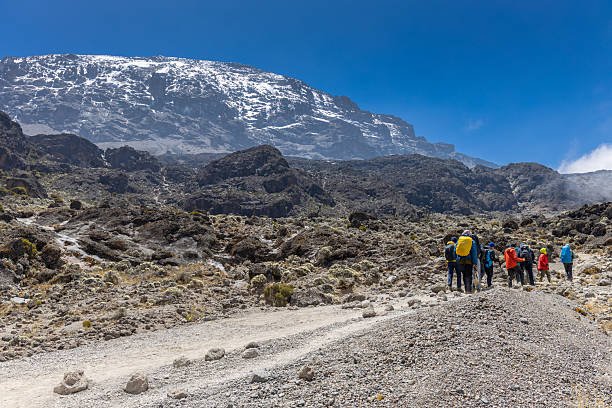
- Walking descent with a guide
- Assisted walking with additional crew
- Ground stretcher evacuation
- Transfer toward a suitable mountain gate
- Vehicle transfer where road access becomes available
- Helicopter evacuation when operationally possible
STEP
04
Transfer for Further Medical Care
After leaving the mountain, the climber may require further assessment or treatment depending on the original problem and current condition.
The destination depends on medical needs, evacuation route, available transport and local arrangements.
Emergency Descent on Kilimanjaro
Descent is one of the most important responses to serious or worsening altitude illness.
As elevation decreases, atmospheric pressure increases and more oxygen becomes available with each breath.
This makes descent fundamentally different from simply resting at the same high camp.
The amount of descent required depends on the climber's condition and the terrain available.
Guides may begin descent immediately rather than waiting until morning when they believe delay would create unnecessary risk.
Walking Evacuation
A climber who can still walk safely may descend with a guide or additional crew.
This can often be faster than waiting for more complex evacuation arrangements.
The pace is adjusted according to the climber's condition.
The climber may receive support on steeper or uneven sections.
Assisted Descent
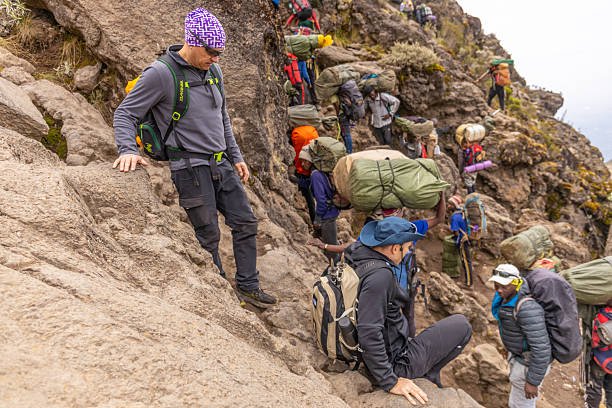
Some climbers can walk but require substantial support.
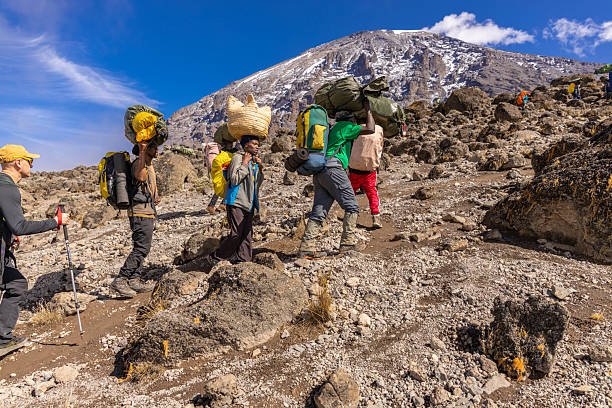
Additional guides or crew may assist with balance, equipment and pacing.
A climber should not try to prove independence if assistance makes the descent safer.
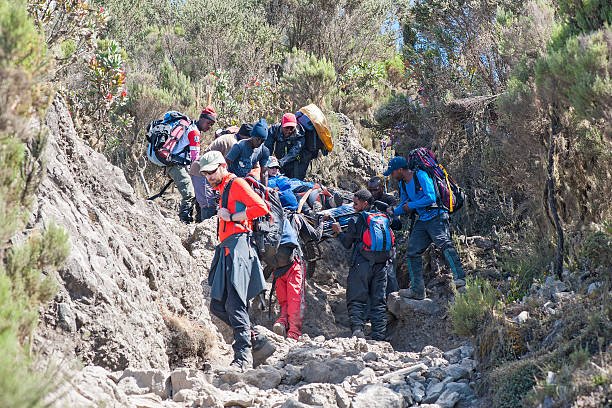
Stretcher Evacuation on Kilimanjaro
If a climber cannot walk safely, a mountain stretcher may be required.
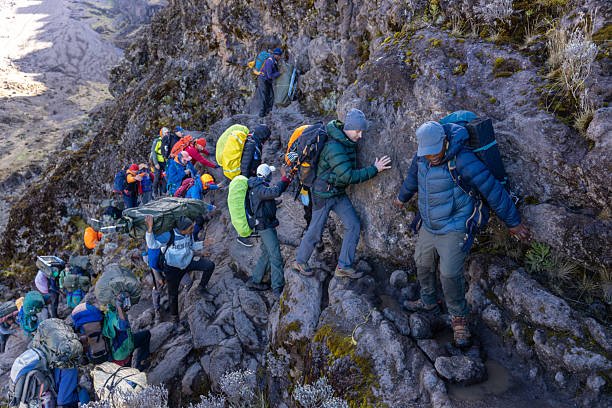
Ground stretcher evacuation can involve a coordinated team moving the climber along suitable trail sections toward a lower point or access area.
The process may be physically demanding for the rescue team because mountain terrain can include rocks, steep trails, mud and uneven ground.
Ground Stretcher Evacuation May Be Used When
- The climber cannot walk safely
- An injury prevents normal descent
- Severe weakness makes walking unsafe
- A medical condition requires faster supported descent
- Helicopter evacuation is unavailable or inappropriate
Helicopter Rescue on Kilimanjaro
Helicopter evacuation can be an important option in some emergencies.
However, a helicopter should never be described as guaranteed rescue from any location on Mount Kilimanjaro.
Whether an aircraft can operate depends on weather, visibility, wind, cloud, the climber's location, suitable operating conditions, aircraft availability and coordination requirements.
Some situations may still require ground movement to a location where an aircraft can safely operate.
Helicopter Evacuation Can Depend On
- Weather conditions
- Cloud and visibility
- Wind conditions
- The climber's location
- Safe aircraft access
- Aircraft availability
- Operational approval and coordination
- Insurance or payment arrangements
Why You Should Never Rely Only on a Helicopter
Weather can change rapidly around Mount Kilimanjaro.
Cloud, wind or visibility can prevent an aircraft from operating safely.
A helicopter may also not be immediately available when an emergency occurs.
This is why every serious Kilimanjaro operation should also have a practical ground evacuation plan.
Climbers should understand that ground descent may begin immediately while helicopter possibilities are assessed.
Emergency Oxygen During Kilimanjaro Rescue
Professional mountain teams may carry emergency oxygen as part of their safety equipment.
Oxygen may be administered when medically appropriate while evacuation or descent is being organised.
Emergency oxygen should not be treated as a way to keep an unwell climber climbing toward the summit.
Emergency Oxygen Does Not Replace
- Necessary descent
- Guide assessment
- Emergency evacuation
- Medical treatment
- Appropriate acclimatization
Pulse Oximeter Monitoring
A pulse oximeter may be used during routine Kilimanjaro health checks to provide estimated blood oxygen saturation and pulse information.
It can be useful for monitoring trends, but one reading should not determine an evacuation decision by itself.
Cold fingers, movement, circulation and measurement conditions can affect readings.
A guide should consider pulse oximeter information together with symptoms, coordination, breathing and the climber's overall condition.
Altitude Sickness and Rescue
Altitude illness is one of the principal reasons climbers may need to descend early.
Early symptoms can include headache, nausea, dizziness, unusual tiredness, reduced appetite or disturbed sleep.
Not every mild symptom requires evacuation, but worsening symptoms require careful assessment.
Serious Altitude Warning Signs
- Confusion
- Major changes in behaviour or alertness
- Severe loss of walking coordination
- Inability to walk normally
- Breathlessness at rest
- Severe respiratory distress
- Rapid deterioration
These symptoms require urgent action and should never be hidden to protect a summit attempt.
High Altitude Cerebral Edema and Evacuation
High Altitude Cerebral Edema, often called HACE, is a severe altitude emergency affecting the brain.
Confusion, altered behaviour and severe loss of coordination are important warning signs.
A climber with suspected severe altitude illness requires urgent action rather than continued ascent.
Descent and emergency management should be organised immediately according to guide and medical protocols.
High Altitude Pulmonary Edema and Evacuation
High Altitude Pulmonary Edema, often called HAPE, is a severe altitude emergency involving the lungs.
Significant breathlessness at rest or severe respiratory deterioration at altitude requires urgent attention.
Emergency descent and medical assistance may be necessary.
Injury Evacuation on Kilimanjaro
Not every Kilimanjaro evacuation is caused by altitude.
Falls, ankle injuries, knee problems or other trauma can make walking difficult or impossible.
The evacuation method depends on the injury, terrain and location.
Possible Injury Response
- Initial assessment
- Basic first aid
- Reducing unnecessary movement when appropriate
- Assisted walking when safe
- Stretcher evacuation when walking is unsafe
- Transport to further medical evaluation
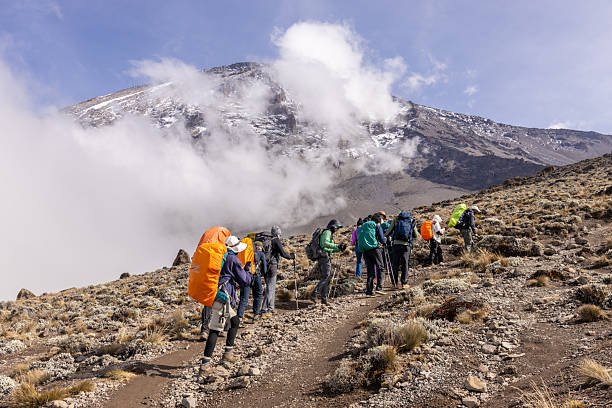
Rescue During Summit Night
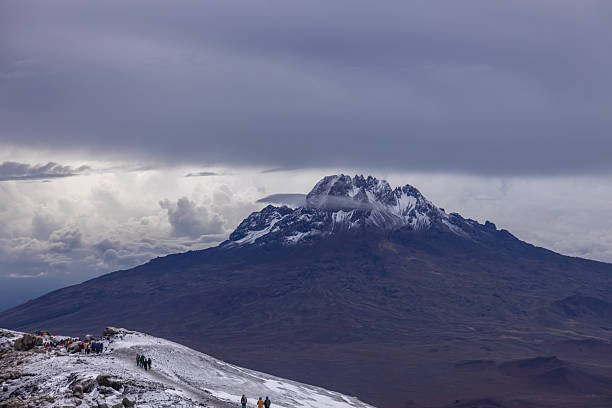
Summit night is one of the most important periods for health monitoring.
Climbers may leave Barafu around late night or midnight and continue toward Stella Point and Uhuru Peak.
The combination of extreme altitude, cold, darkness and accumulated fatigue can cause a climber's condition to change.
If the guide considers the climber unsafe to continue, the correct direction may be downward even when the summit is relatively close.
Turning around below the summit is a safety decision, not a failure.
Rescue From Barafu Camp
Barafu Camp is approximately 4,673 metres and is the standard summit base for routes such as Machame and Lemosho.
Because of the high elevation, symptoms at Barafu should be taken seriously.
A climber who deteriorates before the summit attempt may need to remain at camp temporarily for assessment or begin descent depending on the situation.
Emergency oxygen may be used when appropriate, but it should not delay necessary descent.
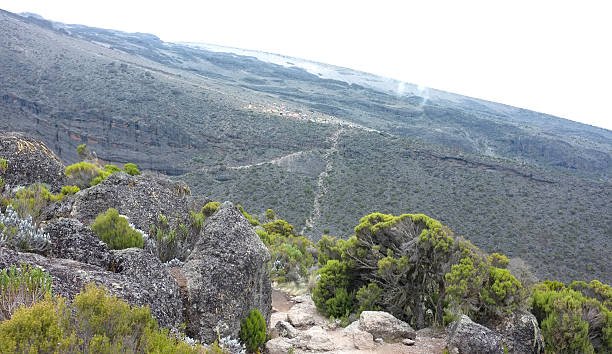
Rescue From Barranco or Karanga
Barranco and Karanga are lower than Barafu but remain high altitude mountain camps.
Evacuation from these areas may involve descent along an appropriate route chosen by the mountain team.
The exact route can depend on trail conditions, the climber's mobility and operational requirements.
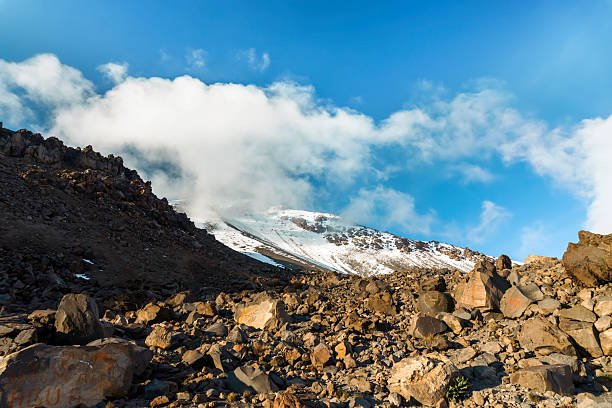
Rescue From Higher Summit Areas
A rescue above the summit camps can be especially demanding because of extreme altitude and limited oxygen availability.
The immediate objective is generally to stop further ascent and move the climber toward lower elevation as safely and efficiently as possible.
A climber should not remain unnecessarily at extreme altitude while waiting for an ideal evacuation method if safe descent can begin.
Can One Climber Descend While the Group Continues?
In some circumstances, yes.
The possibility depends on the number of guides, group size, severity of the emergency and available support personnel.
A well planned operation should have enough leadership capacity to manage an individual evacuation without leaving the remaining group inadequately supervised.
However, every emergency is different and the guide team may modify the entire group's plan when necessary.
What Happens to Your Luggage During an Evacuation?
The priority during an evacuation is the climber rather than nonessential luggage.
The guide team coordinates what essential items should accompany the climber and what equipment can continue with the expedition or be transported separately.
Personal identification, medication, insurance information and critical belongings should remain accessible rather than buried deep inside porter luggage.
Why Travel Insurance Is Important
High altitude rescue and medical treatment can create substantial costs.
Travellers should therefore obtain insurance suitable for Mount Kilimanjaro before beginning the trek.
The policy should specifically cover trekking at the maximum altitude planned rather than simply providing standard holiday medical cover.
Check Your Insurance for Kilimanjaro Rescue and Evacuation
- Maximum trekking altitude covered
- Emergency medical treatment
- Ground evacuation
- Helicopter evacuation where eligible
- Hospital treatment
- Emergency transport
- Trip interruption
- Any high altitude exclusions
- Any requirement for preauthorisation
Does Every Insurance Policy Cover Helicopter Rescue?
No.
Travel insurance policies vary substantially.
A policy may cover ordinary medical treatment but exclude high altitude trekking, helicopter evacuation or activities above a specified elevation.
Read the policy wording before departure and contact the insurer when clarification is required.
Insurance Preauthorisation
Some insurers or assistance companies may require communication or authorisation before certain evacuation costs are covered.
Emergency circumstances can develop quickly, so travellers should keep policy details and emergency contact information accessible.
The exact procedure depends on the insurance company and the seriousness of the situation.
What Documents Should You Carry?
- Travel insurance policy details
- Emergency assistance telephone number
- Passport information
- Emergency contact details
- Relevant medical information
- Medication information
Digital copies can be useful, but essential information should also remain accessible when phone signal or battery power is limited.
Communication During a Mountain Emergency
Communication on Kilimanjaro may involve guides, other crew, park personnel, ground transport, medical providers and evacuation services.
Mobile network availability can vary by route and location, so a rescue plan should not rely solely on a traveller's personal phone.
The guide team should manage operational communication using the systems available to them.
Why Daily Health Checks Matter
The best evacuation is often the one that can be started early before a climber deteriorates severely.
Daily health monitoring helps guides notice problems while a climber is still able to communicate clearly and potentially descend with less assistance.
Daily Monitoring May Include
- How the climber slept
- Headache
- Nausea
- Appetite
- Energy level
- Dizziness
- Breathing
- Walking coordination
- Pulse information where used
- Oxygen saturation where used
Choosing a Longer Route Can Reduce Avoidable Pressure
A longer itinerary cannot guarantee that rescue will never be required.
However, additional acclimatization time can reduce the pressure created by very compressed schedules.
Seven day Machame, longer Lemosho routes and the Northern Circuit provide more time on the mountain than shorter versions.
Every route still reaches high altitude and requires careful monitoring.
Seven Day Machame and Emergency Planning
Seven day Machame normally includes:
- Machame Camp
- Shira Camp
- Lava Tower
- Barranco Camp
- Karanga Camp
- Barafu Camp
- Stella Point
- Uhuru Peak summit attempt
- Mweka Camp
- Mweka Gate
The separate Karanga overnight provides additional time before moving to Barafu.
This can support acclimatization but does not eliminate the possibility of emergency descent.
Lemosho Rescue and Evacuation Planning
Lemosho approaches from the western side before joining the southern circuit.
Depending on itinerary length, evacuation planning must consider the climber's position during the early western stages as well as later sections around Barranco, Karanga, Barafu and Mweka.
The guide team selects the appropriate descent or rescue strategy according to actual location rather than assuming every emergency follows the normal trekking itinerary.
Rongai Rescue and Evacuation Planning
Rongai approaches from the north and commonly descends through the Marangu side after the summit attempt.
Emergency evacuation may follow a different route from the planned climb when the guide team determines another option is safer or faster.
Northern Circuit Rescue Planning
The Northern Circuit reaches more remote northern sections of Kilimanjaro.
This makes professional route knowledge, communication and a practical ground evacuation plan particularly important.
Longer route duration provides acclimatization time but does not remove the possibility of injury or illness.
Marangu Rescue Planning
Marangu uses huts rather than tented camps, but accommodation type does not eliminate rescue requirements.
Kibo and the summit zone remain at very high altitude.
A climber who becomes unwell may still require urgent descent regardless of hut availability.
Can Bad Weather Delay Evacuation?
Yes.
Heavy rain, cloud, wind, poor visibility or difficult trail conditions can affect rescue operations.
Weather is particularly important for aircraft operations.
Ground descent may therefore remain necessary even when helicopter evacuation would otherwise be preferred.
Can Rescue Happen at Night?
Emergency situations do not always occur during daylight.
Guides may decide to begin descent at night if waiting until morning is considered unsafe.
Night movement requires careful lighting, route knowledge and crew coordination.
The decision depends on the climber's condition, terrain and available support.
Does a Rescue Mean the Whole Trip Ends?
For the evacuated climber, the mountain trek will usually end when continuing is considered unsafe.
The remaining group's itinerary may continue when there are enough guides and the situation can be managed safely.
In other cases, the guide team may modify or end the wider trip.
No fixed answer applies to every emergency.
What Happens After an Evacuation?
After reaching a lower access point, the climber may be transferred to accommodation, a clinic or hospital depending on their condition.
A serious incident may require continued observation or medical treatment.
Travellers should follow medical and guide advice rather than immediately planning another strenuous activity.
Can You Attempt the Mountain Again After an Evacuation?
A future attempt may be possible, but the decision should depend on why the evacuation occurred.
Someone evacuated for a serious illness or injury should first understand the cause and recover appropriately.
Medical advice may be appropriate before planning another high altitude trek.
Reducing the Chance of an Emergency Evacuation
No one can remove all mountain risk, but careful preparation can reduce avoidable problems.
Practical Risk Reduction
- Choose an itinerary with appropriate acclimatization time.
- Train for long walking days.
- Use suitable hiking boots.
- Walk slowly.
- Follow guide instructions.
- Eat regularly where possible.
- Maintain appropriate hydration.
- Report altitude symptoms immediately.
- Do not hide injuries.
- Carry prescribed personal medication.
- Have suitable high altitude travel insurance.
- Accept descent when safety requires it.
Questions to Ask Your Kilimanjaro Operator
- How are climbers monitored for altitude illness?
- What first aid training do the guides have?
- Is emergency oxygen carried?
- Is a pulse oximeter used?
- What ground evacuation equipment is available?
- How is an injured climber moved if they cannot walk?
- How is helicopter evacuation requested when appropriate?
- What happens if one member of a group must descend?
- What insurance coverage is required?
- Where is an evacuated climber normally transferred for further care?
What Climbers Should Do Before Departure
Preparation for Kilimanjaro Rescue and Evacuation begins before arriving at the mountain gate.
- Purchase suitable high altitude travel insurance.
- Read the policy carefully.
- Save insurer emergency numbers.
- Share relevant medical information with the operator.
- Bring personal medication.
- Provide an emergency contact.
- Train appropriately.
- Choose a suitable route duration.
- Attend the pre trek briefing.
- Ask questions about emergency procedures before starting.
Important Information About Kilimanjaro Rescue and Evacuation
Kilimanjaro Rescue and Evacuation planning should be part of every serious Mount Kilimanjaro trek.
Most climbers will not require emergency evacuation.
Altitude illness is one possible reason for emergency descent.
Injury or unrelated illness can also require evacuation.
The first priority is the climber's health rather than reaching the summit.
A climber should report symptoms honestly.
Worsening altitude symptoms should not be hidden.
Guides may stop a climber from ascending when they consider continued climbing unsafe.
Descent is an important treatment for serious altitude illness.
Walking descent may be possible when the climber can move safely.
Additional crew may assist a climber during descent.
A mountain stretcher may be required when walking is unsafe.
Ground evacuation remains essential even where helicopter services exist.
Helicopter evacuation cannot be guaranteed.
Aircraft operations depend on weather, visibility, wind, location and availability.
A climber may need to be moved before a helicopter can operate.
Emergency oxygen may be used when medically appropriate.
Emergency oxygen should not be treated as permission to continue ascending with serious symptoms.
Pulse oximeter readings can provide useful supporting information.
A single oxygen saturation number should not replace symptom assessment.
Confusion is a serious warning sign.
Severe loss of coordination is a serious warning sign.
Breathlessness at rest requires urgent attention.
A rescue may take place during daylight or at night depending on urgency.
Weather can affect ground and helicopter evacuation.
The normal trekking route may not always be the route used for emergency descent.
The mountain guide team determines the practical evacuation route according to location and circumstances.
Travel insurance should cover trekking to the planned maximum altitude.
Travellers should confirm emergency evacuation coverage before departure.
Do not assume every policy covers helicopter rescue.
Insurance contact details should remain accessible during the trek.
Important medication and identification should also remain accessible.
The remaining group may sometimes continue after an individual evacuation when guide numbers and circumstances allow.
In other situations, the wider itinerary may need to change.
Longer routes provide more acclimatization time but cannot eliminate emergency risk.
Fitness reduces unnecessary physical strain but does not prevent altitude illness.
Summit success can never be guaranteed.
Turning around or being evacuated is not a failure when continuing would be unsafe.
Travellers with medical conditions or concerns about high altitude trekking should discuss their plans with an appropriate medical professional before departure.
Why Understanding Kilimanjaro Rescue and Evacuation Matters
Understanding Kilimanjaro Rescue and Evacuation procedures gives climbers realistic expectations before they enter the mountain environment.
The goal of emergency planning is not to create fear. It is to ensure that everyone knows what happens when normal trekking can no longer continue safely.
Early symptom recognition, professional guide decisions, prompt descent and suitable emergency equipment can make a significant difference when a problem develops.
Ground evacuation remains a fundamental part of Kilimanjaro safety because aircraft operations can be affected by conditions beyond anyone's control.
Travel insurance is equally important because emergency medical transport and treatment can be expensive.
Most importantly, climbers should understand before starting that reaching Uhuru Peak is optional, while returning safely is the priority.
Frequently Asked Questions About Kilimanjaro Rescue and Evacuation
What is Kilimanjaro Rescue and Evacuation?
It refers to the procedures used to assist a climber who can no longer safely continue and move that person to lower altitude or further medical care.
What is the most common first response to altitude illness?
The guide assesses the climber, stops further ascent when necessary and may begin descent depending on symptoms and overall condition.
Is every Kilimanjaro rescue done by helicopter?
No. Many evacuations use walking descent, assisted descent, stretcher support and ground transport.
Is helicopter rescue available on Kilimanjaro?
Helicopter evacuation may be available in appropriate circumstances, but operations depend on location, weather, visibility, aircraft availability and other operational requirements.
Is helicopter evacuation guaranteed?
No. Climbers should never rely on helicopter evacuation as the only emergency plan.
Can bad weather stop a helicopter rescue?
Yes. Cloud, wind, visibility and other conditions can prevent safe aircraft operations.
What happens if a helicopter cannot fly?
Ground evacuation may continue using walking assistance, stretcher support and transfer toward a suitable access point.
Are stretchers available for Kilimanjaro evacuation?
Mountain stretcher systems can form part of ground rescue arrangements when a climber cannot walk safely.
Can I simply walk down if I feel sick?
A climber who can walk safely may descend with guide support, but the decision and route should be coordinated with the mountain team.
Can rescue happen at night?
Yes. If waiting until daylight would be unsafe, guides may begin emergency descent at night using appropriate support and lighting.
Do guides carry emergency oxygen?
Professional guide teams may carry emergency oxygen according to their safety arrangements.
Can oxygen allow me to keep climbing?
Emergency oxygen should not be used to override serious symptoms or necessary descent simply to continue toward the summit.
Do guides use pulse oximeters?
Some guide teams use pulse oximeters as part of health monitoring, but readings should be considered together with symptoms and overall condition.
What altitude symptoms may lead to evacuation?
Worsening illness, confusion, severe loss of coordination, significant breathing difficulty or another serious deterioration may require urgent descent.
Is confusion serious at altitude?
Yes. Confusion or major changes in alertness at high altitude require urgent assessment.
Is difficulty walking normally serious?
Severe loss of coordination at altitude is a serious warning sign and requires urgent guide attention.
Is breathlessness at rest serious?
Yes. Significant breathing difficulty at rest at high altitude requires urgent attention.
Can an injury require evacuation?
Yes. Significant ankle, knee or other injuries can make safe walking impossible and may require assisted or stretcher evacuation.
Can food poisoning or stomach illness require evacuation?
Severe illness that causes significant weakness, dehydration or deterioration may require a climber to stop and descend.
Can one climber descend while others summit?
Sometimes. It depends on guide numbers, the emergency, group size and whether the remaining group can continue safely with adequate leadership.
Does the entire group have to descend?
Not always. The decision depends on staffing, route logistics and the seriousness of the incident.
What happens to my luggage during evacuation?
Essential items can accompany the climber while other luggage may be managed separately by the expedition team.
Do I need travel insurance for Kilimanjaro?
Travellers should have insurance suitable for high altitude trekking, medical treatment and emergency evacuation.
Does ordinary travel insurance cover Kilimanjaro rescue?
Not necessarily. Policies may contain altitude limits or exclusions, so coverage should be confirmed before travelling.
Should insurance cover helicopter evacuation?
It is sensible to confirm what emergency evacuation methods are covered and whether helicopter rescue has specific conditions or limits.
Can an insurer require approval before helicopter evacuation?
Some policies or assistance providers may have authorisation procedures, so travellers should understand their policy before the trek.
Should I carry my insurance details on the mountain?
Yes. Keep policy information and emergency assistance contact details accessible during the trek.
Does a longer route eliminate evacuation risk?
No. Longer routes provide more acclimatization time but cannot eliminate altitude illness, injury or other emergencies.
Can very fit climbers still need evacuation?
Yes. Fitness does not prevent altitude sickness, injury or unrelated illness.
Does descending improve oxygen availability?
Yes. Atmospheric pressure increases as altitude decreases, making more oxygen available with each breath.
Is turning around considered failure?
No. Turning around when continuing would be unsafe is responsible mountain decision making.
Can I try Kilimanjaro again after being evacuated?
A future attempt may be possible after appropriate recovery and assessment of why the evacuation occurred.
What should I ask an operator about rescue before booking?
Ask about guide training, health monitoring, emergency oxygen, stretcher arrangements, ground evacuation procedures, helicopter coordination and insurance requirements.
Can rescue costs be expensive?
Emergency transport and medical treatment can be expensive, which is one reason suitable travel insurance is important.
Where will I be taken after evacuation?
The destination depends on your condition, evacuation route and required level of care and may include accommodation, a clinic or hospital.
Can rescue arrangements differ by route?
Yes. Machame, Lemosho, Rongai, Marangu and Northern Circuit place climbers in different parts of the mountain, so evacuation logistics can vary.
Is summit success guaranteed if rescue equipment is available?
No. Rescue equipment improves emergency preparedness but does not guarantee acclimatization or reaching Uhuru Peak.
How should I prepare for Kilimanjaro Rescue and Evacuation?
Choose a professional operator, understand its emergency procedures, purchase suitable high altitude insurance, share relevant medical information, carry important documents and follow guide decisions throughout the climb.
Plan Your Climb With Kilimanjaro Rescue and Evacuation in Mind
Choose a Kilimanjaro itinerary with professional guide support, clear health monitoring, ground evacuation procedures, emergency equipment and suitable insurance before beginning your journey toward Uhuru Peak.
Plan Your Kilimanjaro Climb